The start of their anecdote. The album's other cards are for you to discover in the game.
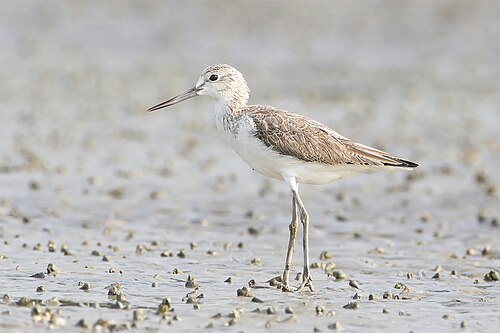
Common greenshank
Scolopacidae
Tringa nebularia · Least concern
Mist gave the common greenshank its scientific name: nebularia comes from the Latin word, a reference to the damp marshes it lives in, just like its Norwegian name, Skoddefoll. This tall wader is one of the largest of the 'shanks' after the willet. It nests on dry ground near marshes, laying about four eggs in a scrape. Its closest relative is the American greater yellowlegs. In Australia it has been listed as endangered.
Photo: JJ Harrison (https://www.jjharrison.com.au/) (CC BY-SA 3.0)
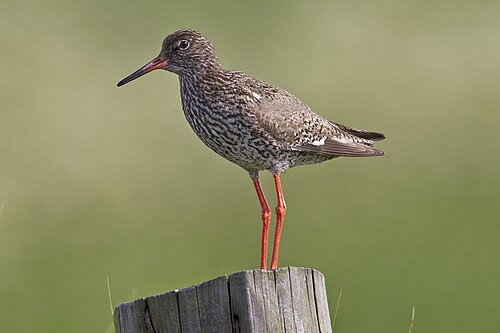
Common redshank
Scolopacidae
Tringa totanus · Least concern
The common redshank owes its name to its bright red legs, matched by a black-tipped red bill. Wary and noisy, it raises the alarm with a loud piping call that alerts every other bird around. A widespread breeder across temperate Eurasia, it sometimes wanders astonishingly far: there are records from Guadeloupe, Brazil and Colombia.
Photo: Andreas Trepte (CC BY-SA 2.5)
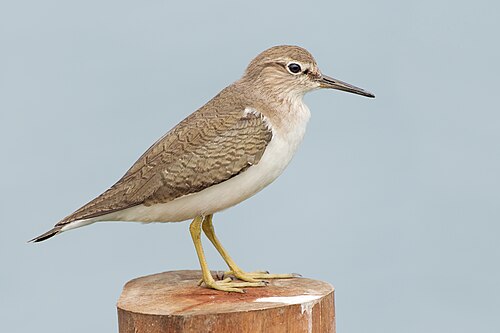
Common sandpiper
Scolopacidae
Actitis hypoleucos · Least concern
Strays sometimes cross the line. The common sandpiper and its American sister species, the spotted sandpiper, replace each other geographically, yet a stray of one may settle with breeders of the other and hybridize. It has even hybridized with the green sandpiper, from another genus. Linnaeus described it in 1758; on the Nukumanu Islands of Papua New Guinea it is called tiritavoi.
Photo: JJ Harrison (https://www.jjharrison.com.au/) (CC BY 3.0)


