The start of their anecdote. The album's other cards are for you to discover in the game.
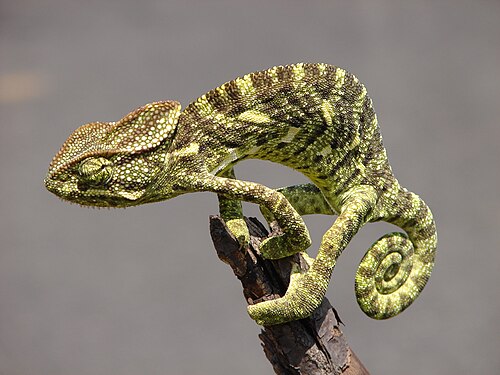
Indian chameleon
Chamaeleonidae
Chamaeleo zeylanicus · Least concern
To mimic swaying branches, it moves slowly with a bobbing gait. Its extremely long, sticky tongue catches insects several feet away, while each eye moves on its own and its tail can grip like a hand. Its colours can change in an instant.
Photo: M.arunprasad (CC BY 2.5)
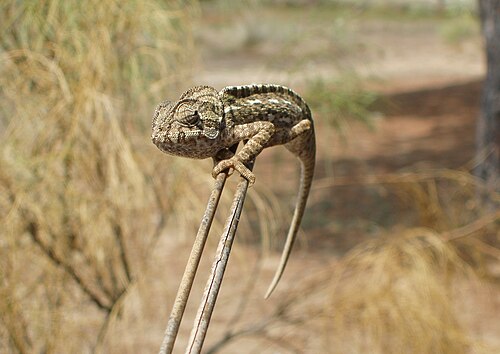
Common chameleon
Chamaeleonidae
Chamaeleo chamaeleon · Least concern
Of all living chameleons, only the common chameleon has a natural range that reaches Europe, and there it is native only to southern Portugal and Spain, southern Italy, Cyprus and the Greek island of Samos. It catches insects by stealth, shooting out a long tongue with a sticky pad at the tip. Its eggs, laid in the soil, take 10 to 12 months to hatch, and the larger females, which lay more eggs, favour males that fight over them.
Photo: Emilio J. Rodríguez Posada (CC BY-SA 3.0)
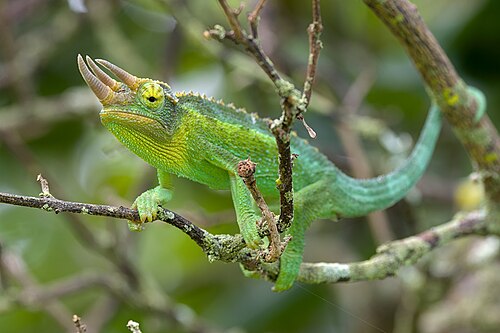
Jackson's chameleon
Chamaeleonidae
Trioceros jacksonii · Least concern
Male Jackson's chameleons carry three horns, one on the nose and one above each eye, a look often compared to Triceratops; the genus name Trioceros means 'three horns'. Native to East Africa, the species was introduced to Hawaii, whose population long supplied the American pet trade until exports became illegal.
Photo: AMMuench (CC BY 4.0)


